Login

Smart homes today already support voice control, identity recognition, environmental sensing, automatic cleaning, and rule-based automation. But in essence, they are still built around intelligent but isolated devices. Real judgment, configuration, and coordination are still handled by people.
As AI agents become more capable, the home will need a more unified AI brain. It will not merely respond to commands, but continuously understand the state of the home and coordinate security, care, appliances, robots, lighting, and reminders.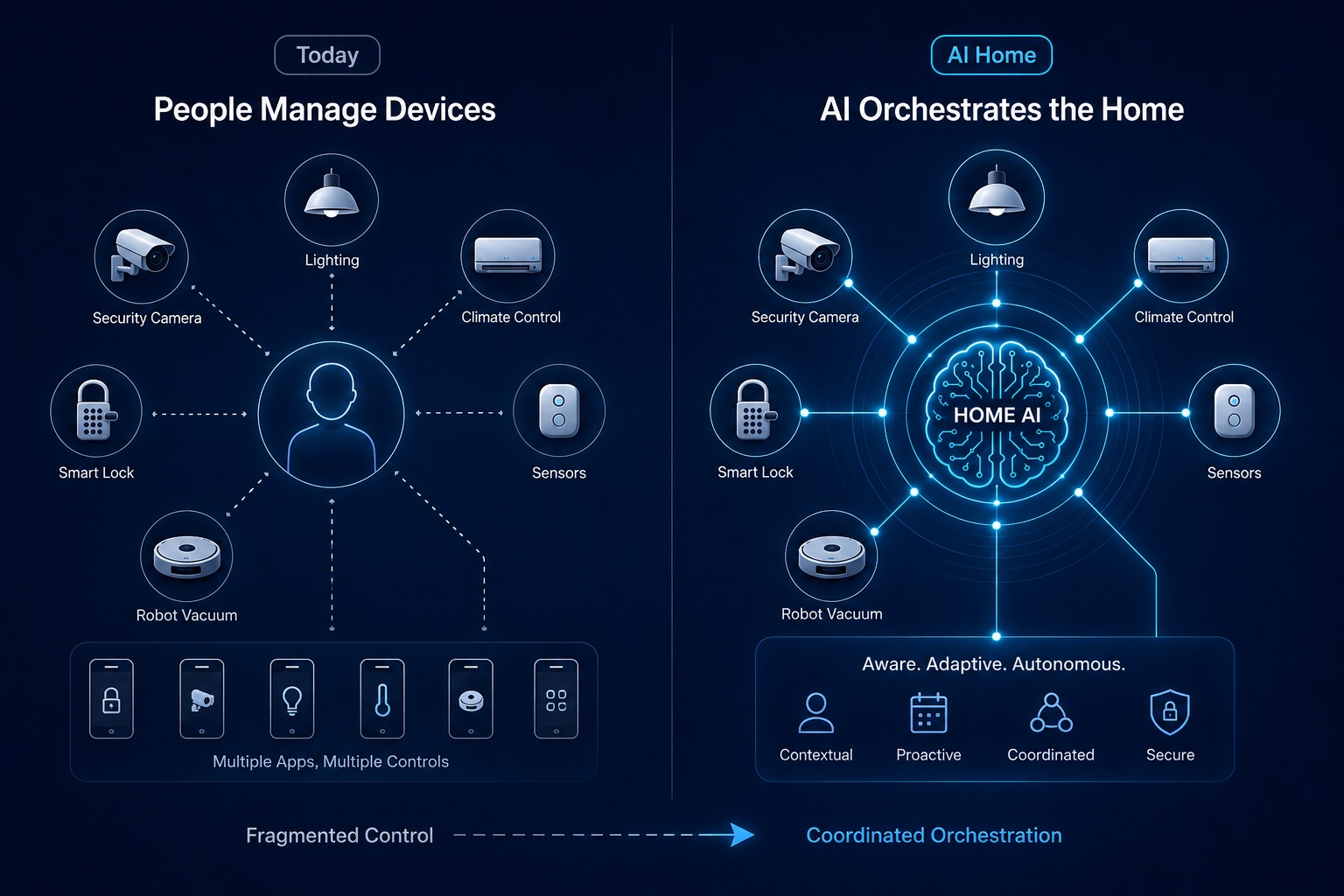
This means the control logic of the home is changing: from people managing devices to AI orchestrating the home.
The industry is already working on the foundations such a system requires. Matter is promoting device interoperability across brands and ecosystems, while Home Assistant emphasizes a more proactive, intuitive, and user-friendly smart home experience. Together, these trends point to one question: how to reduce the complexity of managing home devices.
In this direction, the value of home AI is no longer limited to controlling devices. It will gradually participate in home operations and take on more critical functions such as safety, care, device coordination, and task management.
If AI is only a voice assistant, a network outage simply means users cannot ask questions for a while. If AI is only an entertainment tool, an outage mainly interrupts the experience.
But when AI begins to participate in elderly care, child arrival reminders, lock-camera coordination, robot scheduling, abnormal event alerts, and household task management, the impact of a network outage becomes more complex. It is no longer simply about losing internet access. It affects the continuity of critical home services.
More importantly, these tasks are often not entertainment functions. They are home safety, care, and device-coordination capabilities that need to work at the right moment. For these smart home services, the value does not lie in being available most of the time, but in not failing when they are needed most. If security alerts, elderly care, anomaly detection, or robot coordination become unavailable at the moment of response, their intelligent value is significantly weakened.
Once home AI participates in non-entertainment tasks, the network is no longer just an experience channel. It becomes a prerequisite for whether critical services can function at all.
The evaluation standard for the home network will also extend from whether the speed is fast enough to whether critical intelligent services can stay online.
Whether the future home AI brain is deployed on a gateway, smart display, robot base station, home server, or in the cloud, it still depends on two fundamental resources: power and internet connectivity.
Power already has relatively mature backup systems, such as UPS systems, home energy storage, and backup generators. Connectivity is different. A home cannot store internet access in the same way it can store electricity, and it cannot easily produce internet connectivity by itself. Continuous home connectivity still depends on external links.
When home AI places higher requirements on network continuity, the problem eventually falls on the home gateway: can it provide multi-link, switchable, and manageable external connectivity for the AI brain?
Under this logic, the home gateway is no longer only a device for internet access. It begins to serve as a reliability layer for home AI connectivity.
In the past, Hybrid CPE was usually understood as a multi-access product, such as fixed broadband plus 4G/5G, or fiber plus FWA. Its value was mainly to provide a second access method for different deployment conditions.
But in the home AI scenario, Hybrid CPE gains a new interpretation: fixed broadband as the primary link, and mobile broadband as the backup link.
Fixed broadband handles daily high-bandwidth, low-cost, high-volume connectivity. Mobile broadband takes over critical services when the primary link fails, helping keep the AI brain and critical home services online.
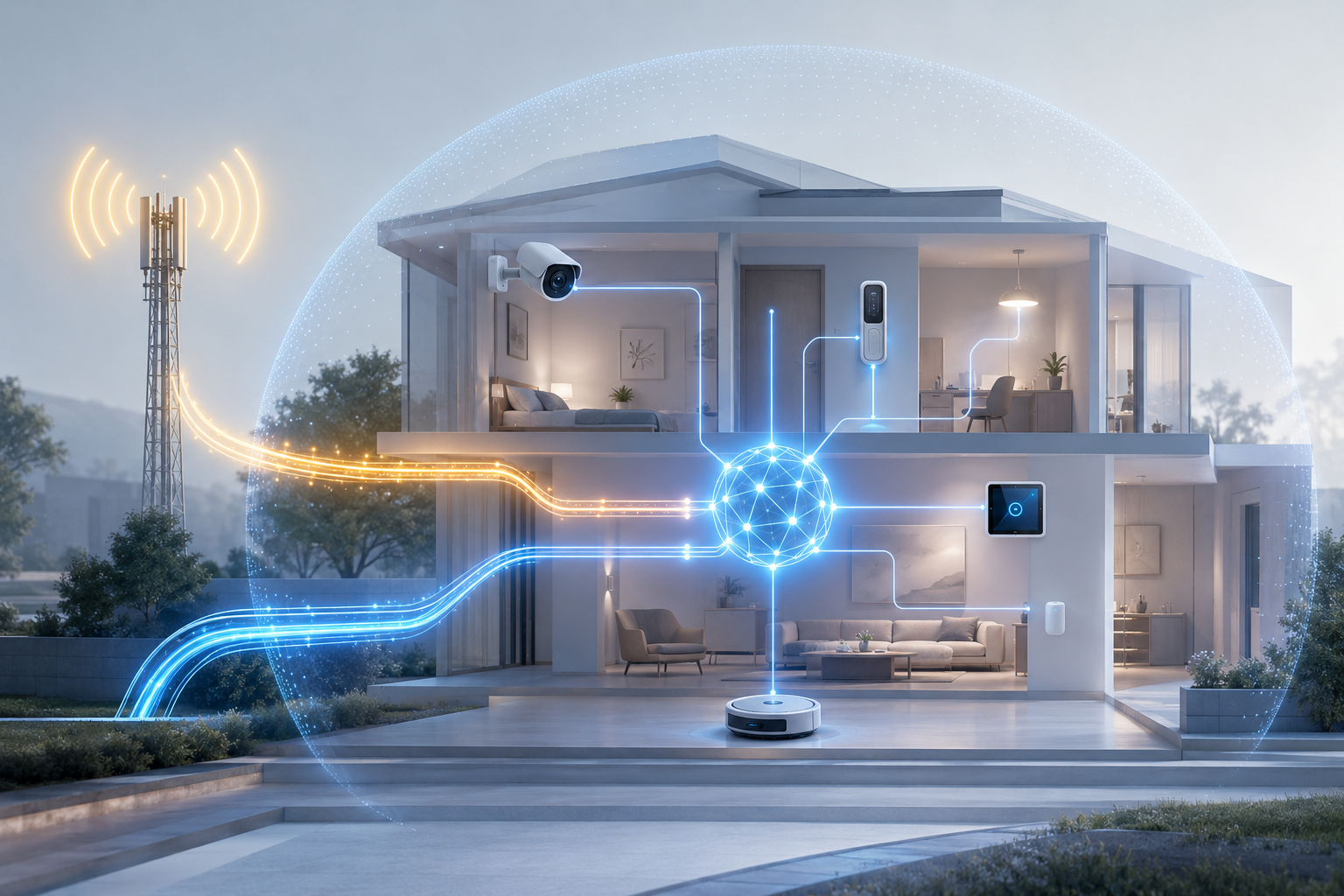
Wireless broadband itself is also becoming an important connectivity form alongside fixed broadband. Ericsson Mobility Report forecasts that FWA connections will grow from 185 million at the end of 2025 to 350 million by the end of 2031. This does not directly prove that Hybrid CPE will become common in home AI scenarios, but it shows that wireless broadband is becoming a more important form of broadband access. From there, one possible inference is that fixed broadband and mobile broadband are not only alternatives in the AI-powered home; they will also become complementary links.
Within this framework, the value of Hybrid CPE is no longer simply one more network option. It provides redundancy assurance for keeping the AI brain online.
A Hybrid Gateway evolving toward AI-powered home scenarios needs more than fixed broadband and mobile broadband. It needs a broader high-availability mechanism.
First, low-perception failover. The gateway needs to detect primary link failures and keep critical services such as the AI brain, security, care, and robot scheduling as uninterrupted as possible.
Second, priority for critical services. When fixed broadband fails, the mobile backup link should not be consumed by TV streaming, game downloads, cloud backups, or system updates. The gateway needs to enter an emergency mode and prioritize the AI brain, security, smart locks, sensors, and care devices.
Third, device and service identification. The gateway should not only know which devices are connected, but also which devices are critical, which services are mission-critical, and which traffic can be downgraded or paused.
Fourth, local fallback. Multi-link connectivity cannot solve everything. Even when the external network is available, cloud AI services, account systems, or platform APIs may still fail. Therefore, the home gateway also needs to support local rules, local device coordination, and basic automation so that the home system does not completely collapse during external failures.
A Hybrid Gateway for the AI-powered home is not just fixed broadband plus a SIM card. It needs critical service identification, connection priority management, and local fallback capability.
If home AI is mainly used for chatting, entertainment, and light smart home control, a single fixed broadband connection may still be enough. Even during a short outage, users can rely on their phones’ mobile networks for personal tasks.
But in high-dependence households, the value of Hybrid CPE will appear earlier. These include homes with elderly people living alone or remote care needs, homes with child monitoring needs, homes that rely heavily on security systems, homes with robots or many smart devices, homes highly dependent on remote work, and high-end residences, smart communities, and senior living homes.
In these scenarios, a network outage is no longer just an entertainment interruption. It affects safety, care, and household management. Therefore, fixed broadband plus mobile broadband backup will become a reasonable configuration earlier.
At the same time, this trend should not be overstated. Gartner’s forecast on agentic AI shows that AI is clearly moving from answering questions toward autonomous execution; however, Gartner also warns that many agentic AI projects remain early-stage and face challenges around cost, maturity, and unclear value. Therefore, Hybrid CPE adoption is more likely to advance in layers rather than all at once.
When home AI raises the requirement for network continuity, the change does not only happen on the gateway hardware side. It also affects how operators define their services.
Today, home broadband services are still often defined by access type, such as fiber, cable, DSL, FWA, or mobile broadband. Users buy a specific access method, and the home gateway mainly distributes that link inside the home.
But in an AI-powered home scenario, what users actually need is not a specific access method, but a continuously available, manageable, and assured home network. Underneath, it can be supported by fixed broadband, mobile broadband, FWA, or other links, while the gateway handles switching and priority management according to task requirements.
Operators may no longer sell only speed or access type, but a home network service with multi-link access support, critical-service prioritization, and remote management capability.
In this model, Hybrid CPE is not just a hardware combination of fixed broadband plus a SIM card. It becomes the entry device for operators to integrate multiple access resources and deliver an overall home network service.
From the operator’s perspective, the value of Hybrid CPE is not only multi-access. It helps upgrade the home network from a single-link service to a multi-link assurance service.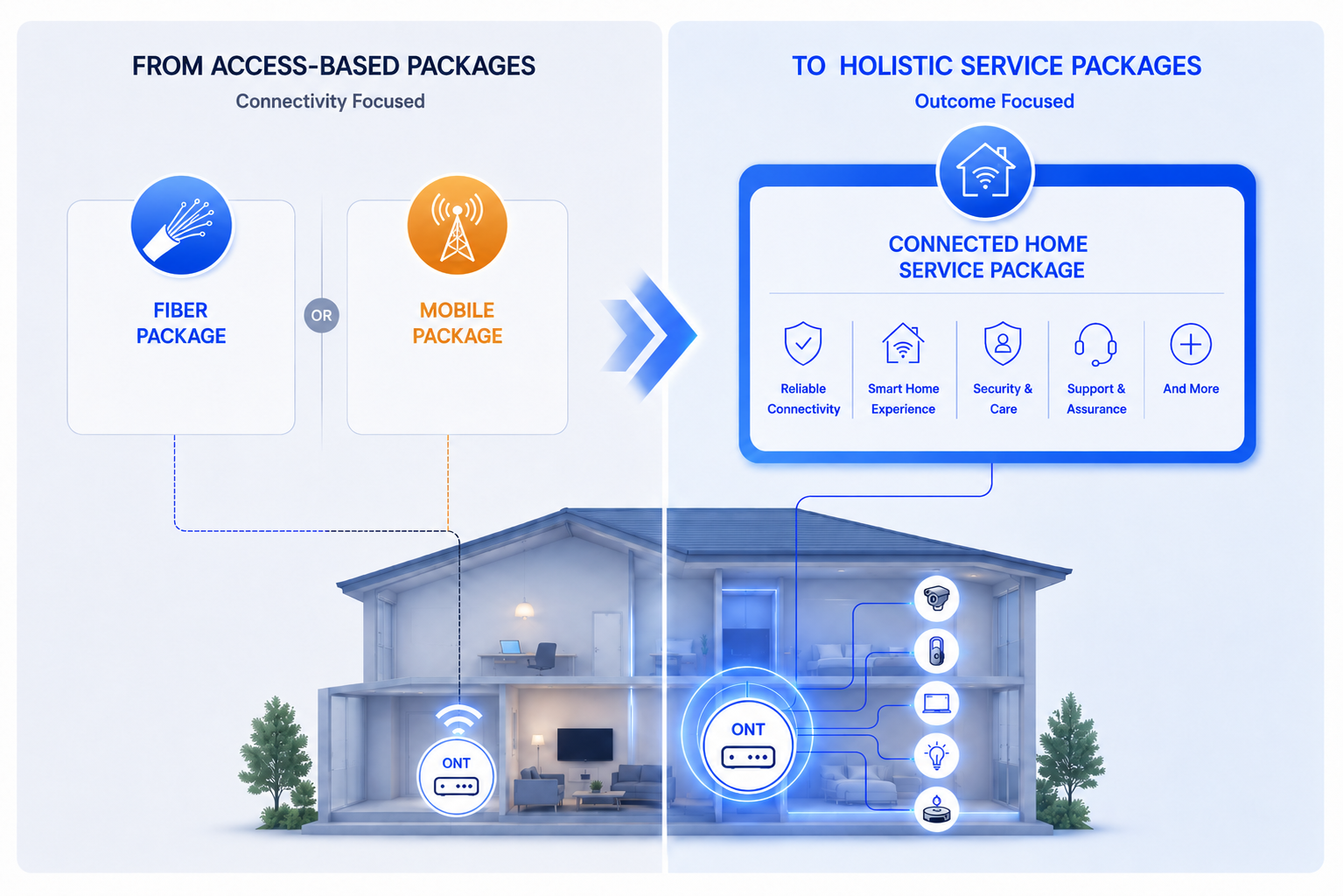
The evolution of home AI is placing higher-level responsibilities on the home network. When AI is only a voice assistant or an entertainment interface, the home network mainly affects user experience. But when AI begins to participate in security, care, device coordination, and robot scheduling, network continuity becomes a fundamental condition for critical intelligent services.
This means the value of the home gateway should not remain limited to internet access. It needs to further support connection assurance, critical-service identification, link switching, local fallback, and remote management, becoming a reliability node within the home AI operating system.
Under this logic, the meaning of Hybrid CPE is also redefined. It is no longer only a combination of fixed broadband and mobile connectivity, nor merely a multi-access terminal for different deployment conditions. It may become a core device form in a high-reliability network architecture for the AI-powered home.
From the user side, Hybrid CPE provides redundancy assurance for keeping critical services connected. From the operator side, Hybrid CPE provides an entry point for integrating multiple access resources into one home network service. From the terminal product side, the competition around Hybrid CPE will shift from how many access methods it supports to whether it can keep critical services running.
The more critical home AI becomes, the more reliability the home network will need. The long-term value of Hybrid CPE may lie not in multi-access itself, but in multi-link assurance for the AI-powered home.